

Cybersecurity in 2025 is more challenging than ever. Have you wondered why use managed security services today?
A recent reddit discussion among IT leaders highlighted common headaches with VPNs, remote work security, and AI-driven phishing attacks. And, it manged to throw light on why managed security services are organizations go to source when it comes to reliable protection.
The global cost of cybercrime is projected to reach $13.86 trillion annually, with phishing attacks linked to generative AI skyrocketing by over 1,200%.
AI-driven threats, sprawling cloud infrastructures, and the rise of remote work have created vast, complex attack surfaces.
Ransomware, phishing campaigns, and supply chain attacks are no longer isolated incidents. They are sophisticated, relentless, and evolving faster than traditional security measures can keep up.
This is where Managed Security Services (MSS) step in. By combining 24/7 monitoring, advanced threat intelligence, rapid incident response, and regulatory compliance support, MSS providers are empowering organizations.
They help them protect critical assets without the cost or complexity of building an in-house security team.
As cyberattacks grow more sophisticated, only Managed Security Services provide the end-to-end expertise businesses need.
What does a Managed Security Service Do?
A Managed Security Service Provider (MSSP) is a third party that manages, monitors and responds to cyber threats on behalf of clients, providing complete protection, compliance and risk reduction.
Managed Security Services are crucial for modern businesses navigating a complex cyber world. MSSPs bring together technology, expertise and operational processes to deliver proactive protection against emerging threats.
Why Use Managed Security Services in 2025?
Cyber threats are evolving faster than ever, and businesses need proactive, expert-led protection to stay ahead. Managed Security Services provide the visibility, speed, and expertise required to detect and neutralize attacks before they impact operations.
- 24/7 Monitoring & Threat Detection in endpoints and cloud environments.
- Incident Response & Remediation of breaches.
- Regulatory Compliance Support and auditing for GDPR, HIPAA, PCI-DSS and other frameworks.
- Threat Intelligence & Advisory on emerging risks and vulnerabilities.
- Vulnerability Management & Risk Assessment of critical security holes.
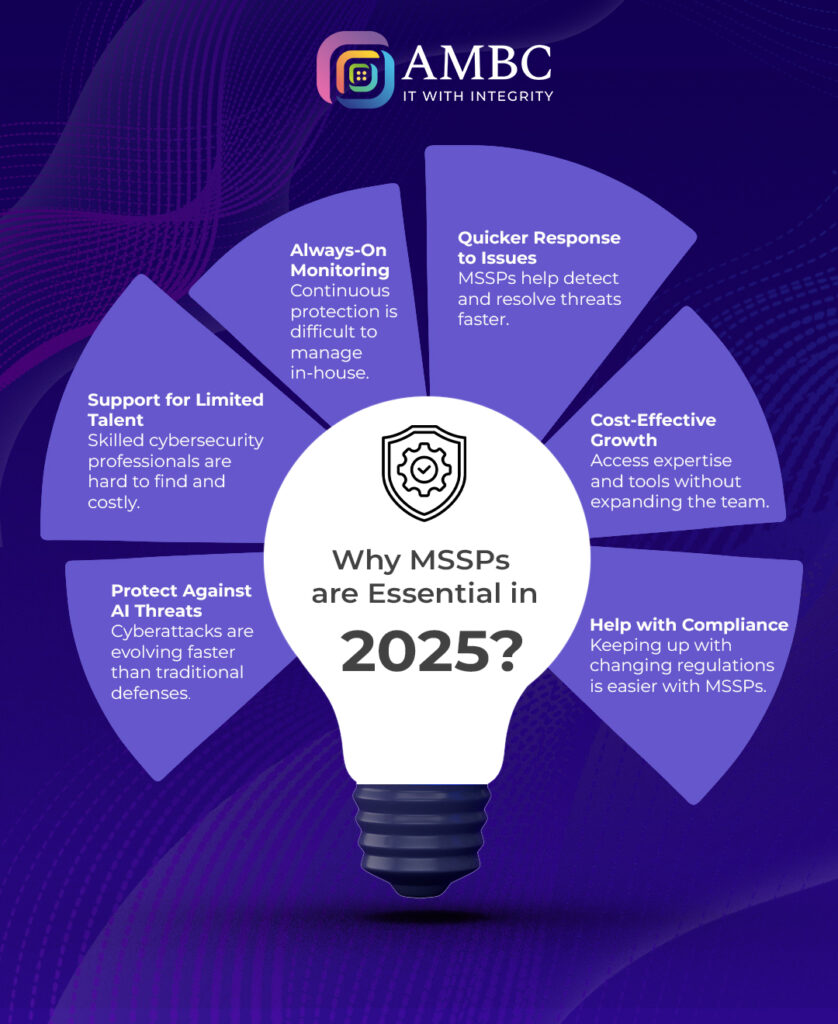
In 2025 MSSPs are essential because:
- Attackers use AI and machine learning to get past traditional security.
- Cloud and hybrid environments expand the attack surface.
- Talent shortages make in-house security teams expensive and hard to scale.
With MSSPs you get expertise, predictive threat intelligence and scalable security – all without the overhead of building an internal SOC.
Challenges Managed Security Services Face and How to Overcome Them?
Cyber threats in 2025 are faster, smarter, and more complex than ever. Organizations face gaps in monitoring, compliance, and skilled security talent. Managed Security Services address these challenges with expert-led, 24/7 protection and scalable solutions.
| Challenge | Problem | Managed Security Services Solution |
| 24/7 Cyber Threat Exposure | Organizations face continuous attacks but often lack round-the-clock monitoring. | MSSPs provide 24/7 Security Operations Centers (SOC), real-time alerts, and rapid incident response. |
| AI-Driven and Evolving Threats | Zero-day exploits, AI-generated phishing, and polymorphic malware bypass traditional defences. | MSSPs deploy AI/ML-driven threat detection, predictive analytics, and automated remediation workflows. |
| Regulatory Compliance Complexity | GDPR, HIPAA, and PCI-DSS regulations are complex and frequently updated. | MSSPs offer automated compliance monitoring, regional expertise, audit support, and reporting dashboards. |
| Skill Shortages in Security Teams | Certified security experts are scarce, making it hard to maintain an in-house SOC. | MSSPs provide access to expert teams, advanced threat hunting, and 24/7 incident response without recruitment overhead. |
| Budget & Resource Constraints | Building in-house enterprise-grade security infrastructure is expensive. | MSSPs offer cost-effective, scalable solutions with predictable monthly costs, eliminating the need for expensive hardware and software. |
| BYOD & Cloud Risks | Remote work and BYOD devices increase vulnerabilities, while cloud apps may be misconfigured. | MSSPs enforce endpoint security, mobile device management, and cloud security posture management (CSPM). |
| Shadow IT & Insider Threats | Employees may deploy unapproved apps or bypass security protocols. | MSSPs provide monitoring, policy enforcement, and awareness training to reduce insider risks. |
| Third-Party & Supply Chain Vulnerabilities | Malicious actors exploit vendor networks to compromise organizations. | MSSPs assess vendor risks, monitor third-party access, and integrate threat intelligence across supply chains. |
In a nutshell,
- MSSPs provide end-to-end coverage from monitoring to incident response.
- Predictive analytics and AI allow proactive threat mitigation.
- Regulatory and operational compliance becomes manageable, even for SMBs.
- MSSPs scale with the organization, providing enterprise-grade protection at lower cost.
Real-World Case Study of AMBC- Securing a Global Enterprise
AMBC worked with a major commercial bank to improve cybersecurity across multiple regions. By using continuous monitoring, AI-powered threat detection and automated incident response AMBC achieved:
45% reduction in cyber incidents across the network
Ransomware attacks on critical systems prevented
Compliance with regional and international regulations including GDPR and industry specific standards
Faster response times to potential threats, minimal downtime and business disruption
The results show how Managed Security Services can help organisations protect their data, business continuity and scale globally without the cost and complexity of an in-house security team.
This case highlights the ROI of MSSPs and why businesses are turning to them as strategic cybersecurity partners. Use these results to help you choose the right MSSP for your organisation’s security needs, operational requirements and regulatory obligations.
How to choose an MSSP?
Choosing the right Managed Security Service Provider is key to aligning your cybersecurity strategy with your business goals. Evaluating expertise, service scope and responsiveness will get your organization maximum protection and ROI.
Key Evaluation Criteria
- Expertise & Industry Experience with a proven track record in your sector.
- Service Scope & Technology Stack to handle AI driven threat intelligence.
- AI & Threat Intelligence for predictive analytics and real-time monitoring.
- Support & Responsiveness in case of any rapid incidents.
- Scalability & Cost that are not overwhelming and alarming.
Align MSSP services with your business challenges, regulatory requirements and budget to get maximum protection and ROI.
What’s the Market Trend for Managed Security Services?
- AI-Driven Security for predictive threat detection and automated remediation.
- Cloud-Native MSSP Solutions ensures protection across hybrid and multi-cloud environments.
- SMBs and Regional Compliance ensuring local regulation compliance.
- Scalability for Evolving Threats, by responding at the right time
Take Away
The best managed IT services are no longer optional; they are strategic cybersecurity partners for organizations navigating 2025’s complex threat landscape. so, no point it pondering about why use managed security services.
By leveraging MSSP solutions in partnership with an expert IT consultancy, businesses can achieve continuous monitoring, AI-driven threat intelligence, regulatory compliance, and cost-effective protection.
Evaluate Managed Security Services with us to safeguard your organization against evolving cyber threats and ensure business continuity in 2025.
