

Technology keeps your business running—from daily operations to customer service. But when IT breaks down, everything grinds to a halt. Systems crash, productivity stalls, and security risks appear at the worst possible time. For small and mid-sized businesses, the impact can be devastating. In fact, 60% of businesses shut down within six months of a major cyberattack (National Cyber Security Alliance).
And the threat is only getting bigger: Cybercrime is set to cost the world $10.5 trillion annually in 2025, with estimates rising to $15.63 trillion by 2029 (Cybersecurity Ventures).
That’s why more business leaders ask: Should I keep IT in-house or partner with a Managed IT provider who can handle it all?
Managed IT vs. In-House IT: Key Differences
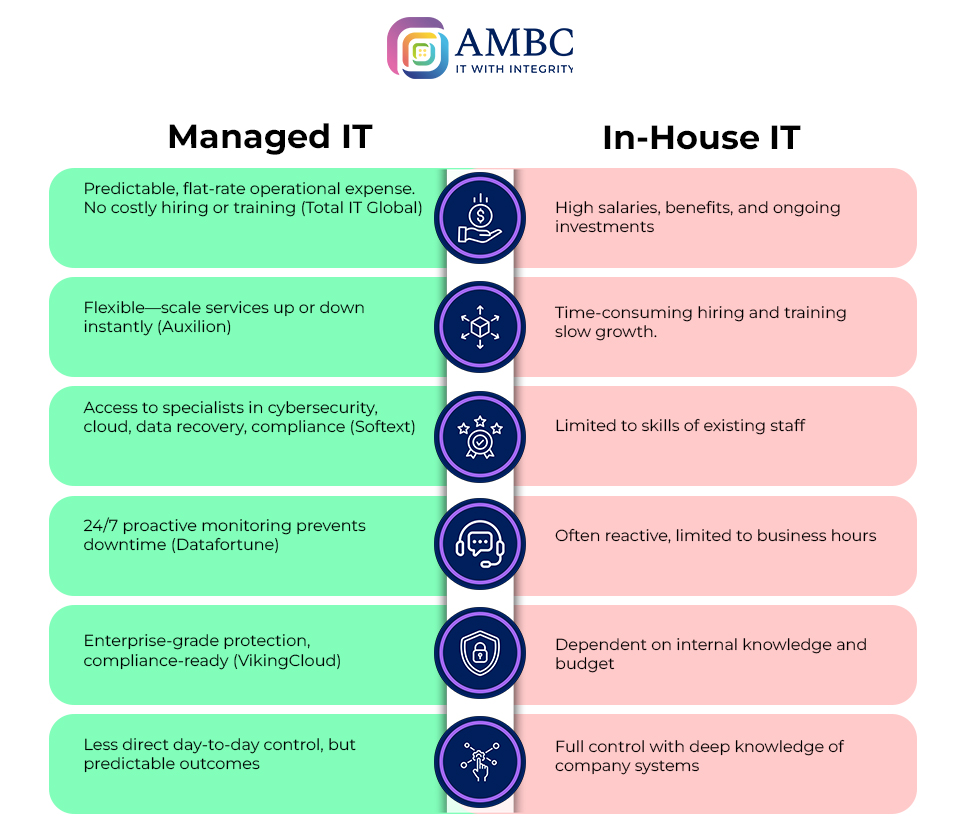
For a quick refresher, explore: Managed IT Services Guide
The Case for Managed IT: Growth Accelerator
For many growing businesses, Managed IT offers a strategic advantage:
- Predictable Costs & ROI: Transform large, unpredictable IT expenses into a single flat-rate fee. Gartner reports companies adopting managed services reduce IT costs by up to 30% (US Cloud).
- Robust, Proactive Security: With cyber threats constantly evolving, 24/7 monitoring and proactive detection are essential.
- Expertise on Demand: From cloud migrations to compliance audits, MSPs provide diverse skills, reducing reliance on limited internal hires.
- Scalability: The global managed services market is projected to hit $879 billion by 2032 (Fortune Business Insights) showing how essential MSPs have become to global business growth.
- Productivity Gains: Proactive monitoring resolves issues before downtime strikes. With the cost of downtime averaging thousands of dollars per minute, continuous availability is critical.
See more: 12 Reasons Why Small Businesses Are Turning to Managed IT Providers
The Case for In-House IT: Control and Culture
In-house IT is valuable for businesses with highly complex systems or strict compliance needs. Advantages include:
- Full Control: Direct oversight of IT processes.
- On-Site Presence: Faster response to physical system issues.
- Culture Fit: Staff deeply embedded in business operations.
However, challenges include high staffing costs, limited expertise, and slow scalability.
The Hybrid Approach: Co-Managed IT
For companies wanting the best of both worlds, co-managed IT is a smart middle ground. Businesses keep internal IT for daily needs while leveraging an MSP for 24/7 monitoring, cybersecurity, and advanced projects. This model offers:
- Gap coverage during off-hours or absences.
- Access to specialists without full-time hires.
- Cost efficiency with knowledge sharing.
Take Away
The global cost of cybercrime is projected to reach $10.5 trillion annually by 2025, with small businesses making up a significant portion of victims (Qualysec) IT management is no longer just about convenience—it’s about survival.
For most growing businesses, Managed IT services are not just a cost-saving tool but a growth strategy. By outsourcing IT, leaders can secure operations, scale with confidence, and focus on what matters most—innovation and growth.
Not sure which IT model is right for you? Let’s explore your options. Talk to our experts today and discover how Managed IT can strengthen your business for the future.